Special Guest Instructor

Dr. Tavis Dickerson-Young, MD
Pediatric Emergency Medicine Physician, Seattle
Course Summary
Children are not small adults. They desaturate faster, their airways obstruct more easily, and the right dose for one child can be too much for the next. This two-day course strengthens your approach to pediatric sedation with practical education focused on patient screening, monitoring, anesthesia safety, and emergency rescue.
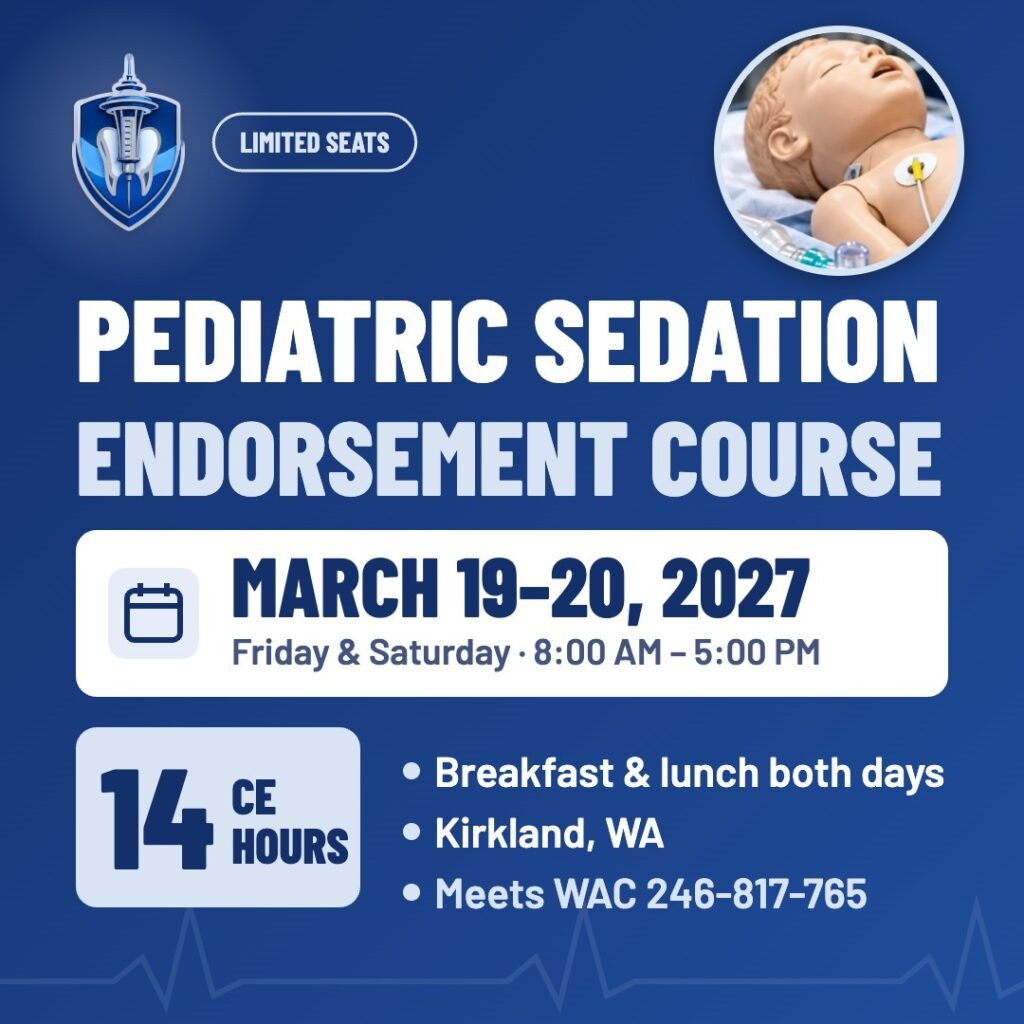
The course is designed to satisfy the 14-hour pediatric sedation training component required by WAC 246-817-765 and to address pediatric sedation continuing education requirements under WAC 246-817-773. It is intended for dentists pursuing pediatric sedation endorsement training or completing CE for an existing endorsement.
We are pleased to welcome special guest instructor Dr. Tavis Dickerson-Young, MD, a pediatric emergency medicine physician practicing in Seattle. Dr. Dickerson-Young teaches alongside Michael Mielniczek, CRNA, and James Prince, CRNA, and brings his experience caring for children in the emergency department to discussions of pediatric assessment, recognition of complications, and emergency management.
Together, the instructors connect pediatric sedation principles to practical decisions in the dental office, from identifying patient risk before treatment to recognizing deterioration and responding effectively.
Who Should Attend?
- Dentists with a moderate sedation permit (enteral or parenteral) who need the pediatric sedation endorsement to sedate children
- Dentists who already hold the endorsement and need 14 hours of pediatric sedation CE for renewal
- Dentists with an enteral permit who want to use intranasal midazolam for pediatric patients, which requires the endorsement
- Dentists who treat young, anxious, or medically complex children
- Any sedation provider who wants practical, real-world training focused on pediatric patient safety
Course Highlights
- 14 CE hours over two days, built around the pediatric sedation training content listed in WAC 246-817-765
- Emergency Medicine Meets Anesthesia: a pediatric emergency medicine physician and two nurse anesthesiologists (CRNAs) who have provided anesthesia in more than 250 Washington dental offices (adult and pediatric)
- Hands-on training and simulation in pediatric airway rescue and emergency response, designed to meet the rule’s requirement of at least 4 hands-on hours
- Weight-based dosing, routes of administration, and nitrous oxide combinations explained for the drugs dentists actually use
- Practical, case-based teaching tied to the decisions you make in your own office
- Breakfast and lunch included both days
Learning Objectives
By the end of this course, participants will be able to:
- Describe the pediatric anatomical and physiological differences that affect sedation, including airway size and shape, tongue and tonsil size, higher oxygen consumption, and faster desaturation.
- Evaluate a child for office-based sedation using medical history, ASA physical status, airway examination, and red flags such as snoring or sleep apnea, recent respiratory infection, and syndromic or cardiac conditions, and recognize when to modify the plan or refer.
- Apply age-appropriate behavioral management techniques before and while sedating medication is given and during the procedure, and recognize behavior that signals over- or under-sedation.
- Select pediatric sedation medications and calculate weight-based doses, including maximum local anesthetic doses, and compare oral, intranasal, and inhalation routes by onset, peak effect, and duration.
- Explain how nitrous oxide combined with other sedating medications deepens sedation, and identify the dosing and monitoring adjustments the combination requires.
- Describe the appropriate use, indications, informed consent, monitoring, and documentation of immobilization (protective stabilization) devices.
- Monitor a sedated child with pulse oximetry, capnography, and clinical observation, and recognize hypoventilation and airway obstruction before oxygen saturation falls.
- Prevent, recognize, and manage pediatric sedation complications, including airway obstruction, laryngospasm, apnea, vomiting and aspiration, and paradoxical reactions, and use reversal agents appropriately.
- Demonstrate pediatric airway rescue in hands-on simulation, including positioning, adjunct sizing, two-person bag-mask ventilation, team roles, and early EMS activation.
- Complete a pediatric sedation record that documents the pre-sedation evaluation, informed consent, weight-based dose calculations, time-based vital signs, discharge criteria, and written caregiver instructions.
How This Course Meets WAC 246-817-765
| Required pediatric sedation training content |
Learning objective |
| Pediatric-specific anatomical and physiological considerations |
1, 2 |
| Pediatric behavioral management while sedating medication is given and during the procedure |
3 |
| Pediatric drugs, dosages, and routes of administration |
4 |
| Appropriate use of immobilization devices |
6 |
| Recordkeeping |
6, 10 |
| Nitrous oxide in combination with other sedating medications |
5 |
| Prevention, recognition, and management of complications |
7, 8 |
| At least 4 hours of hands-on instruction or simulation (observation alone does not count) |
9 |
Course Topics
- Pediatric anatomy and physiology: the differences that affect sedation, airway management, and patient safety
- Patient screening and evaluation: medical history findings and risk factors that shape sedation planning
- Pediatric behavioral management: approaches to supporting children during sedation and treatment
- Sedation medications: pediatric drug selection, dosages, and routes of administration
- Nitrous oxide and medication combinations: what changes when nitrous oxide is combined with other sedating medications
- Patient monitoring: recognizing changes in ventilation, oxygenation, and clinical condition
- Immobilization and documentation: appropriate use of immobilization devices and clinical recordkeeping
- Complication prevention and emergency rescue: recognizing and managing sedation complications
- Hands-on training and simulation: practicing pediatric emergency response and rescue skills
Meet Your Instructors
- Tavis Dickerson-Young, MD: Pediatric emergency medicine physician practicing in Seattle, bringing an emergency department perspective to pediatric assessment, recognition of complications, and emergency management.
- Michael Mielniczek, CRNA: Nurse anesthesiologist and co-founder of Washington Dental Anesthesia Academy, providing office-based dental anesthesia year-round.
- James Prince, CRNA: Nurse anesthesiologist and co-founder of Washington Dental Anesthesia Academy, providing office-based dental anesthesia year-round.
Event Details
| Dates |
Friday and Saturday, March 19–20, 2027 |
| Time |
8:00 AM – 5:00 PM both days |
| Location |
J.A. Avots Dental Education Center & ZBLC Lab
12006 98th Ave NE, Suite 200, Kirkland, WA 98034 |
| CE Credit |
14 CE hours (both days required) |
| Tuition |
$3,000 |
| Meals |
Breakfast and lunch included both days |
| Format |
In person: lecture, case discussion, hands-on training, and simulation |
| Instructors |
Tavis Dickerson-Young, MD; Michael Mielniczek, CRNA; James Prince, CRNA |
The Pediatric Sedation Endorsement: What Washington Requires
Since January 1, 2025, Washington dentists need a pediatric sedation endorsement to provide moderate sedation with enteral (oral) or parenteral (IV) agents to pediatric patients (WAC 246-817-765). To obtain the endorsement, you need:
- A valid moderate sedation with enteral agents or parenteral agents permit
- Training from a CODA-accredited residency in pediatric dentistry, oral and maxillofacial surgery, or dental anesthesiology, or at least 37 hours of minimal and moderate sedation training plus 14 hours of pediatric sedation training
- Current BLS and PALS certification
This course provides the 14-hour pediatric sedation training component. It does not replace the 37-hour minimal and moderate sedation training or PALS certification.
Already endorsed? Endorsement holders need 14 hours of pediatric sedation CE every 3 years (WAC 246-817-773). Those hours may also count toward your moderate sedation CE requirement.
Intranasal midazolam: A dentist with a moderate sedation with enteral agents permit and the pediatric sedation endorsement may give intranasal midazolam to pediatric patients without a parenteral permit. Intranasal drugs for patients over age 12 require a parenteral or general anesthesia permit.
Ready to Register?
Seats are limited to keep hands-on time high. Complete both days to earn 14 hours of CE and build practical skills for safer pediatric sedation in your office.
Questions? Call (978) 413-2215 or email wadentalanesthesia@gmail.com